
Commercial EV charging for hotels: Why 94% of UK hotels are missing a critical revenue stream

Commercial EV charging for hotels is no longer a future consideration - it is a present-day revenue opportunity. Yet up to 94% of UK city hotels still do not offer EV charging, despite over 67% of EV drivers prioritising hotels with charging when booking accommodation - in or outside a city.
For hotel owners and operators, the real return on investment from EV charging is not primarily electricity revenue. It is higher occupancy, improved guest loyalty and a competitive advantage in online search results and booking platforms.
This guide explains:
How commercial EV chargers increase hotel room revenue
Why most hotel EV charging ROI calculations are wrong
How payment systems directly affect guest experience
And why contactless, no-app EV charging is now the hospitality standard
If you are evaluating EV charging for your hotel car park, this article breaks down the full commercial case - not just the hardware.
The transformation is already underway, but most hotels haven't noticed yet. Only 6% of city hotels with parking in the UK offer EV charging, as published by Drax in a 2024 article. No doubt that number has improved. Yet a 2023 SMS white paper stated that 67% of UK EV and plug-in hybrid drivers said charging facilities influenced their choice of hotel. 48% said they would not stay at a hotel without onsite charging.
Considering the increase in EV and Hybrid drivers in the UK, these numbers have certainly increased in 2026 and will continue to do so - as projected in the chart below:
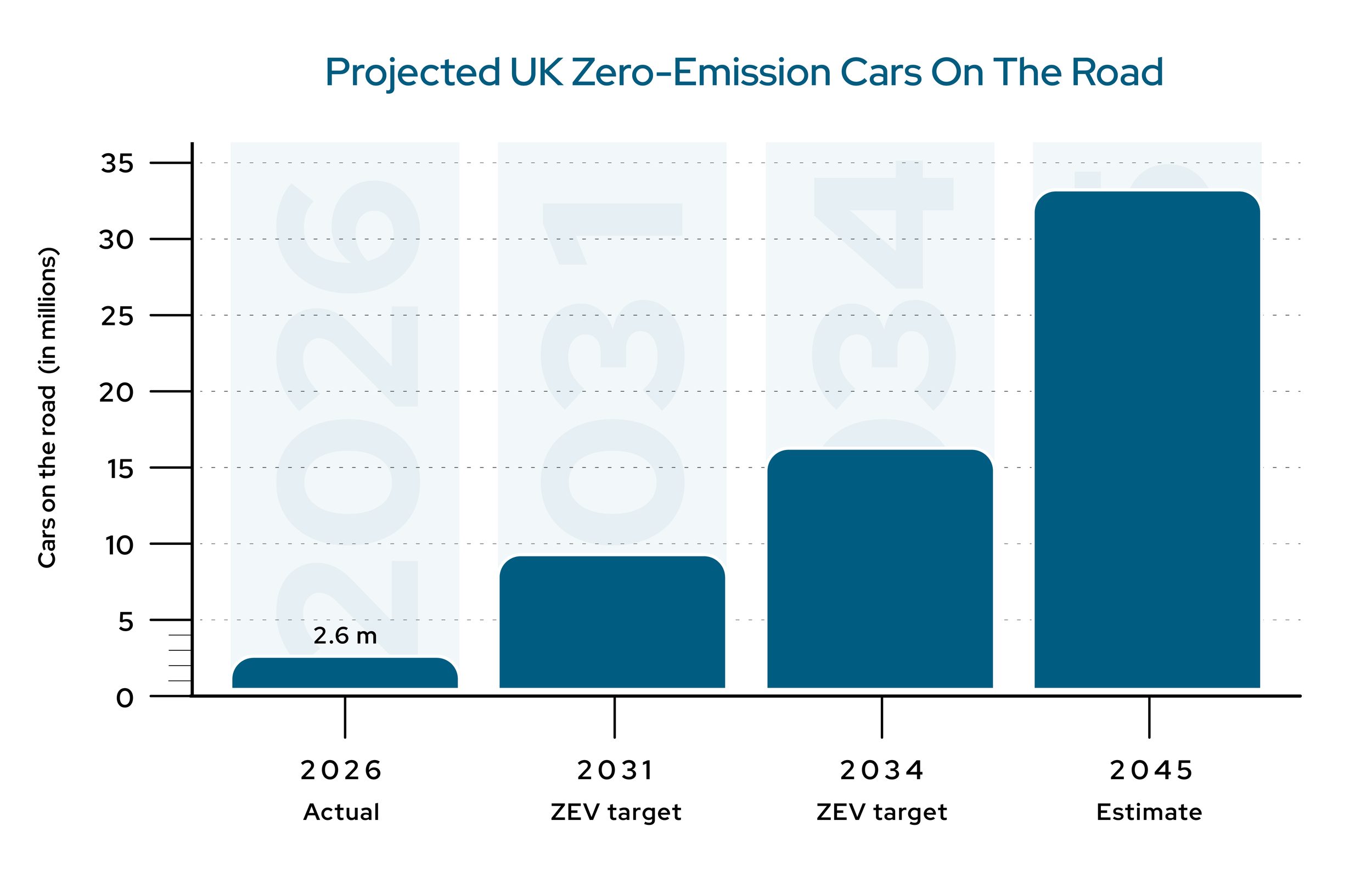
2026 is actual DfT data. 2031 and 2034 are modelled from ZEV mandate new-car targets. 2045 is an indicative midpoint between CCC’s 2040 pathway and DfT’s 2050 high-electrification scenario.
More stats about the increase in EVs can be found on ZapMap’s website here: www.zapmap.com/ev-stats/ev-market
For an industry where occupancy rates and customer loyalty drive profitability, these numbers reveal a striking disconnect between what guests want and what most properties offer. Choosing the right hotel EV charging solution determines whether your investment drives bookings or generates complaints.
The real business case isn't what you think
Return on Investment (ROI) analysis for commercial-grade EV chargers sometimes focuses narrowly on profit from charging fees. If you own your EV charging station, the return on your investment appears straightforward:
The formula for a single charging session:
Total kWh consumed per charging session
Profit per kWh (retail tariff minus electricity cost minus payment processing fees)
Session profit = 1 x 2
How much money you make across an entire year depends entirely on how many EVs visit your location and charger. However, even for an averagely well utilised charger, a hotel might realistically generate £1,000 to £2,000 per bay per year.
This calculation misses the actual value proposition entirely.
Industry research reveals the critical insight: 50% of EV drivers actively choose hotels specifically because they offer charging. Consider what this means for a hotel. Filling just one additional room per week due to EV charging availability translates to £6,000 to £8,000 in annual room revenue alone, before accounting for food, beverage, spa services, or other ancillary spending that accompanies an overnight stay.
The true hotel EV charging ROI isn't measured in electricity sales. It's measured in room occupancy, guest loyalty, and competitive differentiation.
A revenue generating EV chargerisn't just a utility; it's a customer acquisition tool that helps capture a growing segment of travellers actively filtering their accommodation searches by charging availability.
But here's the trap most hotels fall into: install a charger with poor payment experience and you get the worst of both worlds. You've spent £3,000 to £8,000 per bay to attract EV guests, then actively driven them away with app downloads, RFID card hassles, and reception queues. Those negative reviews don't just cost you charging revenue, they cost you the incremental room bookings you installed the infrastructure to capture in the first place.
Why hotels haven't acted
If the business case for EV charging is compelling, why have 94% of UK hotels not installed charging infrastructure? The hesitation stems from a web of interconnected concerns about complexity, cost, uncertainty, and operational impact.
Capital cost and payback anxiety. Commercial EV charger installation UK costs typically range from £3,000 to £8,000 per bay. Traditional payback analysis based solely on electricity revenue suggests a 5 to 7 year return, an uncomfortable horizon when hotel budgets face competing demands.
But this analysis systematically undervalues the incremental room bookings that drive the actual return. The calculation shifts dramatically when charging infrastructure is viewed not as a utility amenity but as a marketing investment that differentiates the property in online search results and booking platforms.
Operational complexity concerns. Hotel managers already juggle countless responsibilities. When you install EV chargers in hotel car park locations, questions arise: Who monitors the chargers? What happens when something breaks? How do we handle guest complaints or confusion? Will this create additional workload for reception staff? These operational uncertainties loom larger than the hardware cost itself.
Guest experience and access control. Hotels need to balance accessibility with control. Should charging be free or paid? Available only to guests or open to the public? How do you prevent non-guests from using the limited charging spaces?
Technology choice paralysis. The market offers numerous charging brands, power ratings, connectivity options, and feature sets. Hotel operators without technical expertise struggle to evaluate competing claims. Which specifications actually matter for the hotel use case? What represents genuine value versus unnecessary features?
The payment system challenge: Where most hotels fail
Among all the concerns hotels face with EV charging, one factor proves most consequential: how guests actually pay to charge their vehicles. The payment system fundamentally shapes whether your charging infrastructure becomes a valued amenity or a source of guest frustration and operational burden that actively destroys your investment thesis.
Here's the regulatory gap that matters: UK rules mandate contactless payment for public charge points over 8kW. Yet the ideal EV charger for hotel car park overnight stays operates at 7kW. Just below the threshold. This means the exact use case where guest experience matters most has no payment requirements at all. Most hotel chargers therefore, ship with app-based or RFID systems that would be inadequate for public forecourts, creating precisely the friction that undermines your competitive advantage.
Contactless vs App-based vs RFID charging
When evaluating hotel EV charging solutions, the payment system creates the most significant operational difference between systems. The choice essentially comes down to contactless vs app vs RFID-based charging, and the implications for guest experience couldn't be more different.
App-based systems frustrate guests. EV drivers already juggle 4 to 7 charging apps. Your hotel adds another, requiring downloads, account creation, and reliable mobile coverage. Hotels report 20% to 30% of guests need reception assistance to start charging. That's not a training issue. It's friction built into the system. Friction that turns your £5,000 investment into a TripAdvisor liability.
RFID cards burden operations. One major hotel group calculated that card distribution and retrieval consumed 15 to 20 hours of monthly reception time across its properties. Cards get lost, forgotten in rooms, or taken home. Staff manage inventory and handle lost card fees: time generating zero revenue while creating queues during busy check-in periods.
The payment experience determines whether your charger investment protects or undermines your competitive advantage. Poor payment UX doesn't just reduce electricity revenue. It actively destroys the room revenue ROI that justified the infrastructure investment in the first place.
What about free charging?
Some hotels offer free charging for guests, eliminating payment friction entirely. This works if you view chargers purely as an amenity (like WiFi) and can absorb the electricity costs, typically £3 to £5 per guest per night.
But free charging creates its own problems: no ability to manage demand, no deterrent against abuse from non-guests, and no revenue contribution during off-peak periods when the public could generate income. Most critically, you're leaving money on the table from guests who expect to pay for charging and view it as a normal transaction.
The optimal approach: frictionless payment that feels effortless (tap and go) but captures hotel EV charging revenue and enables demand management.
Why tap to pay solutions work
Hotels chose contactless payment terminals for restaurant bills and spa services because they match guest expectations and eliminate operational friction. The same technology makes tap-to-pay EV charging for hotels equally as simple.
EV charging without apps represents the future for hospitality. A no-app EV charger for hotels delivers what operations require:
For guests: Works identically to every other hotel transaction. If they can pay for dinner, they can charge their vehicle. No apps, no cards, no learning curve. Simply tap to pay and charge. This seamless experience protects the room booking value that justified your infrastructure investment.
For operations: Zero reception involvement. No inventory to manage. No support queries. Staff need no special training because the contactless EV payment terminal works exactly like existing payment terminals.
For marketing: When you advertise "convenient EV charging" on booking platforms, contactless payment actually delivers that promise. App-based and RFID systems do the opposite, creating the friction that generates negative reviews and undermines your competitive advantage. Costing you both electricity revenue AND the incremental room bookings you're chasing.
Voqa One: The complete hotel EV charging solution
Most EV chargers are designed for public forecourts or workplace car parks. Hotels need something different: destination charging that delivers hotel-grade guest experiences without destroying the investment thesis.
When evaluating an EV charger with contactless payments, hotels face a critical choice. Many suppliers offer basic EV chargers with payments as costly add-ons or complex integrations. Voqa takes a different approach: our commercial EV charger with payments is engineered as a complete system from day one.
Voqa One is the ideal hotel EV charging solution UK, purpose-built for the hotel environment. As a commercial EV charger with contactless payments, it eliminates the friction that undermines your competitive advantage while protecting both revenue streams you're targeting.
A reliable commercial EV charger perfectly matched to overnight charging. Voqa's 7kW EV charger is the best EV charger for hotels, providing 13 hours of overnight EV charging for guests who arrive at 7pm and depart at 8am. This replenishes any EV on UK roads, adding 200+ miles of range. No need for expensive rapid chargers that guests don't require.
EV charger with built in payment terminal engineered from day one
The contactless EV payment terminal is integrated into the unit from the design stage, not retrofitted. Voqa's EV charger with card reader accepts all major contactless cards, Apple Pay, and Google Pay. Guests tap to pay exactly the same as they pay for dinner or drinks. The system handles authorisation, session management, and digital receipts. No apps. No RFID cards. No reception involvement.
This seamless payment experience protects your investment by ensuring that the differentiator you spent £5,000 per bay to install doesn't become a liability that drives guests to competitors.
Your revenue, your control.
The competitive advantage window is closing
The data points in a clear direction. Over 80% of EV drivers prioritise hotels with charging when searching for accommodation. Half actively choose properties specifically because they offer it. For hotels, the business case extends far beyond electricity revenue: it's about filling more rooms and attracting more valuable customers.
The 94% of UK hotels without charging infrastructure face a straightforward choice: invest in a hotel EV charging solution that serves the market already emerging, or continue optimising for yesterday's customer base while a competitor captures tomorrow's. The commercial EV charger installations that succeed don't just prepare for the future. They capture advantage in the present, but only if the payment experience protects rather than destroys the investment thesis.
Install the wrong system, and you've spent thousands to actively drive guests away. Install the right system and you've created a genuine competitive differentiator that delivers value from both electricity revenue and incremental room bookings.
Ready to calculate the real impact on your property?
Use our hotel EV charging ROI calculator to see how charging infrastructure could increase your annual revenue through both electricity sales and incremental room bookings.
