
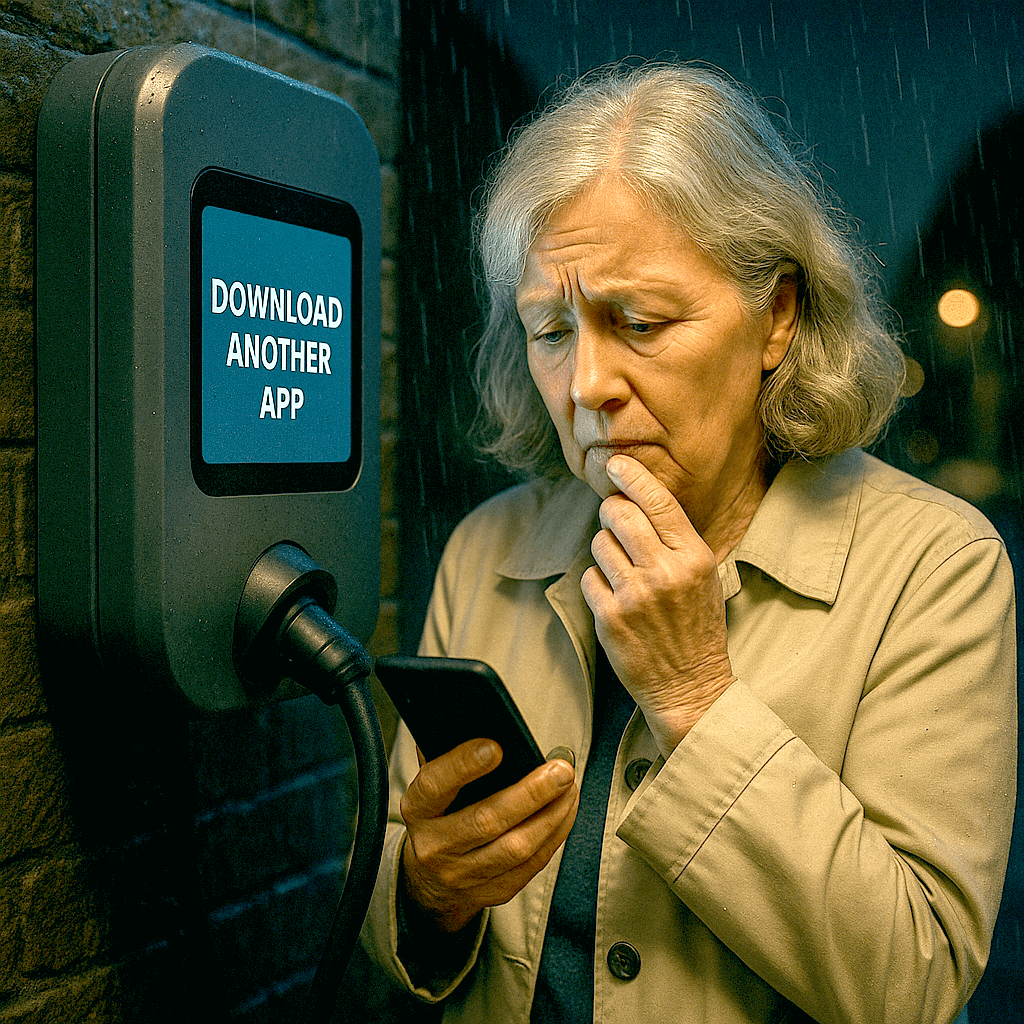
‘I want another EV charging app’ - Said no one. Ever.
National EV Week (1st to 5th of December) is about celebrating progress and being honest about what still needs fixing. And we have made real progress. The ultra-rapid network is growing, charging speeds are improving, and finally, contactless payments are becoming standard on motorway chargers.
But there's a problem we're not talking about enough.
There's a moment that happens in car parks across the UK every single day. An EV driver pulls up to a charger, gets out of their car, walks over to the unit, and then stops. They're looking for instructions. Looking for a QR code. Looking for anything that tells them how to make this thing work.
And then they pull out their phone.
I've watched this happen hundreds of times. Sometimes I'm that driver. More often, I'm the one they approach with the question: "What app do I need for this charger?"
I can't say for sure, but I bet there are more than 30 various apps to choose from. And yes, there are some that roam across networks, but do you have the right app?
‘I want another EV charging app’, said no one. Ever.
The app problem
Sometimes it's a sunny day. They're not in a rush. No drama. Just mild frustration at having to download yet another app, create yet another account, and add their payment details for the fourth time that month.
Other times? It's anything but. It's raining. They're late for a meeting. Their phone signal is patchy. And they're standing in a hotel car park, staring at a charger with a QR code, genuinely stressed about something that should be as simple as filling up with petrol. Turns out we might have made it more complicated.
This isn't about technology failing. The problem is friction. The barrier between wanting to charge and actually charging. Apps add EV charging friction. Friction slows adoption.
The regulations got half the job done
In November 2024, the UK government mandated contactless payments for public EV chargers. It was a victory for common sense. Years of driver frustration finally crystallised into policy. Finally, right?
Well, sort of.
The regulations require contactless payment on all new public chargers above 8kW and all existing chargers above 50kW. There's no requirement to retrofit existing chargers below 50kW.
But the 7kW charger at your hotel? The 22kW charger at the leisure centre? The destination chargers where people actually spend time while their car charges?
Apps. Still apps.
EV drivers will just ‘figure it out
The Department for Transport's reasoning was that chargers slower than 8kW:
"tend to be based in local on-street settings and are usually used habitually by drivers who are familiar with the payment app."
Let me translate that: "Regular users will figure it out."
But here's what they missed: destination charging isn't just for regulars. It's for everyone else too.
It's for the business traveller at your hotel who's never used that charging network before. It's for the family visiting your leisure centre for the first time. It's for the couple stopping at your restaurant who just want to top up while they eat.
These aren't habitual users. They're occasional users. And occasional users are exactly the people who need it to be effortless.
And yet we're forcing occasional users (the very people on the fence about EVs) to navigate app stores, account creation, and payment setup before they can charge at a destination venue.
Who are we actually designing for?
Earlier this year, I attended the She's Electric event at Daylesford Organic. I was there to listen. I was pretty much the only bloke in the room that day. I did feel a bit out of place and a bit self-conscious (everyone was very welcoming though!)
Someone said something that's stuck with me: "My grandparents have the desire and wherewithal to purchase an EV. But the apps make it far too complicated."
Not the range. Not the charging network coverage. Not the price. The apps.
Think about where we are today with EVs. About 1.5 million on the road out of roughly 30 million cars in total in the UK. We've moved past the innovators and early adopters, the people who quite like complexity (because it makes them feel clever) and into the early majority.
But we're still far from mass adoption. The next 28.5 million buyers aren't us. They're everyone else. And everyone else just wants to pull up, plug in, tap, and charge.
This is the audience we need to build for in the long term.
We've already solved this. Everywhere else.
Remember when contactless payments arrived? We all thought it was witchcraft. Now we tap our cards dozens of times a day without thinking. On buses, in shops, at coffee stands, at car parks.
It's universal. It's instant. It's effortless.
We figured out how to make payments invisible. We put in the hard work so that customers didn't have to think.
And then destination EV charging got a free pass to stay complicated.
Why?
The uncomfortable truth
Apps secure your data. Apps enable customer lock-in. Apps equal control.
Contactless doesn't. Someone taps, pays, and leaves. Businesses get their money, EV Drivers get their electricity. Transaction complete.
The regulations forced this change on rapid chargers because they had to. Public pressure and driver frustration.
But destination charging? Lower power. Lower visibility. Lower priority.
And so apps remain. Because nobody made us change.
For charge point operators, apps made business sense. They build databases. They create switching costs. They generate user data that inform pricing strategies and network expansion.
But somewhere along the line, we forgot to ask: What does the customer actually want?
My controversial take
Every destination charger that requires an app is actively slowing EV adoption.
Not might be. Not could be. Is.
And here's where the regulations got it backwards: rapid chargers serve experienced EV drivers doing long journeys who probably already have multiple apps. They're the ones who can cope with complexity. They're doing 200-plus-mile trips. They've planned their route. They know the networks.
Destination chargers serve occasional users. First-timers. People trying EVs for the first time at your business.
And some EV charging networks are still making drivers download an app.
But your guest, tired from a long drive, just wanting to check in and relax, has to stand in your car park troubleshooting an app they've never used before. Maybe the WiFi password is in their room, which they haven't accessed yet. Maybe their phone signal is poor. Maybe they're just not particularly tech-savvy.
That's not a value add. That's a pain point. And pain points don't appear in your marketing materials or your sustainability reports.
We can do better
At Voqa, we've made a bet. We think contactless will beat apps at destination charging. We think the future looks like every other payment you make: pull up, plug in, tap, done.
Our chargers come with contactless payments integrated as standard, not as an afterthought or an expensive retrofit. And we include tethered cables because, frankly, nobody wants to wrestle a wet, dirty cable into their boot after they've finished charging.
The regulations might not require contactless for EV chargers under 8kW. But that doesn't mean it's not the right thing to do.
Because I keep thinking about those drivers who ask me which app they need. And I keep thinking about those grandparents who want an EV but won't buy one because of apps.
And I think: we can do better than this.
What needs to happen
National EV Week is about accelerating adoption. Here's how we actually do it: stop hiding behind what the regulations require and start doing what helps people.
Remove friction. Make it effortless. Design for the typical user, not the enthusiast.
For business owners: when you're choosing EV charging infrastructure, ask the hard questions:
Will your guests, visitors or customers need to download an app?
Will they need to create an account before they can charge?
What happens if they have poor phone signal in your car park?
For the industry: we can't keep designing for ourselves. We need to design for the person who's never owned an EV, who's considering one, who's trying to work out if this transition is as complicated as it seems.
For charge point operators: yes, apps give you data and lock-in. But they also give you friction and complaints. And in a market that's still growing, removing barriers matters more than optimising margins.
Or, we can keep pretending apps aren't a problem at destination charging and wonder why hotel guests complain, why leisure centre members give up, why restaurant customers drive to the next place instead.
Your choice.
For some quick answers, head to our EV charging payment FAQs page. Get in touch for a deeper understanding.
