
Why does charging my car need an app?!
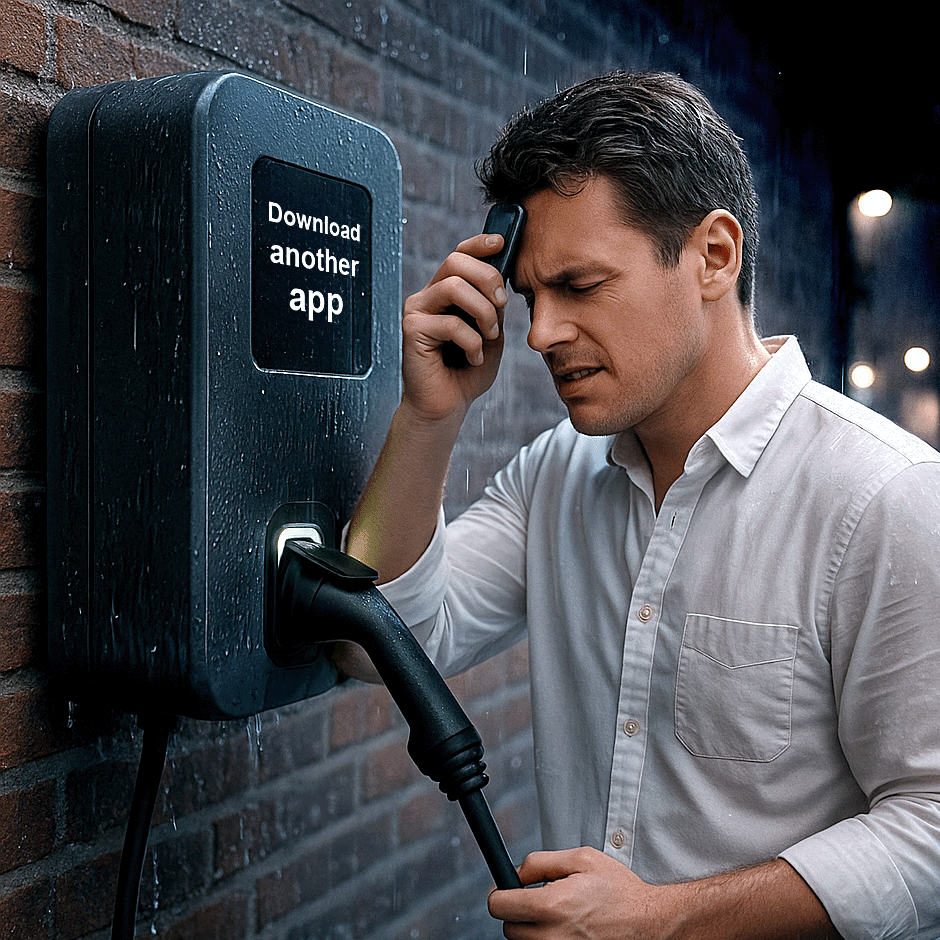
I recently drove four hours from home to attend an investment summit in Exeter. I arrived, cranky and ready to get on with my day. All I needed to do was park and pay. Simple enough, or so I thought.
The only option to pay for parking was via an app. Not one that I had already downloaded (of course, so that's another one to add to the collection). Fortunately, it was sunny, there was a mobile signal, and I had time to spare. Even so, it took ten minutes to pay for parking. And what did I get at the end of it, given that this company now had all my details? A nice countdown clock on my phone screen. Plus a 30p transaction fee for the privilege.
This was not a unique experience nor one limited to parking apps. It's happening (or should I say happened) in destination EV charging. Hotels, golf clubs, co-working spaces, leisure venues, the places where people want to be, have opted for an app based payment experience when it comes to EV charging. Sometimes it is not sunny and time is of the essence - downloading and creating a new account on an unfamiliar app is not putting your best foot forward when it comes to customer experience!
Here's the thing about apps: we didn't collectively decide they were the answer to everything. (Some) businesses did, and it's not hard to understand why. An app means an account, an account means data, and data means a relationship they own and can monetise long after you've driven away. Every time I buy a coffee from a major chain now, someone asks if I want to use their app. No. No, I do not. I just want the coffee, to pay for it and go (usually with a polite thank you!)
We buy train tickets, hotel rooms, lunch, almost everything in daily life, with a tap of a card or phone. At some point, the destination charging industry looked at that and thought: but what if we made it harder?
Stories I have uncovered in recent weeks
I've been collecting feedback from installers and venues recently, and the same themes keep coming up.
Golf club, Oxfordshire. No mobile signal in the car park. Drivers have to walk into the pro shop, ask for the WiFi code, download the app, start a charge then head back to their car to check it has worked. On a bad day, the download fails and they give up.
Hotel, Aberdeen. Guests had to come to reception to collect an RFID card before they could charge. The complaints got bad enough that the hotel eventually just set the charger to fee free, giving away electricity, to avoid the hassle. The technology worked. The experience didn't.
Co-working space, Wiltshire. Members had to register their car with the office before they could start a charge.
In each case, the charging system is designed well for the purpose of getting an electron into an EV battery, not for the person holding the cable.
Getting destination charging right isn't complicated
Payment is central to the driver experience. The moment someone decides to charge, they want to do it quickly and get on with their day.
We already have the infrastructure for frictionless payments. It's called contactless. Drivers use it dozens of times a week without thinking. And it's worth noting that the ultra rapid charging sector (the big ones you find at motorway service stations... and McDonalds) has already been pointed firmly in this direction. UK regulations now require ultra-rapid hubs to offer contactless payment as standard. The destination charging market has no such mandate yet, but the direction of travel is clear. The question is why so many destination operators are still waiting to catch up (the answer to most questions is just follow the money... or in this case specifically the cost)
At Voqa, we built the Voqa One around a simple premise: Charging should be effortless. Tap a card or phone, and charging starts. No app, no account, no trip to reception. It's not a revolutionary idea. It's just the obvious one.
Destination charging operators want to offer EV charging as a genuine guest benefit. That only works if the guest experience actually works. A charger that requires a ten-minute setup process isn't really a benefit.
A broader consequence worth thinking about
It's easy to forget that early EV adopters were, by and large, a self-selecting group. They were comfortable with technology, enthusiastic about change, and willing to navigate a few rough edges to be part of something new. The charging experience was designed, consciously or not, with that person in mind.
But EV ownership is no longer a niche choice, and the next wave of drivers looks very different. Ask yourself honestly: would your parents be comfortable navigating an app-based payment system in a car park or hotel car park, potentially without signal, potentially for the first time? If the answer is no, then the current destination charging experience isn't a minor inconvenience. It's a genuine barrier to adoption for a large part of the population that we need to bring along.
The EV charging industry has done a remarkable job of enabling the transition to EV. Getting the EV Driver experience right is what comes next.
